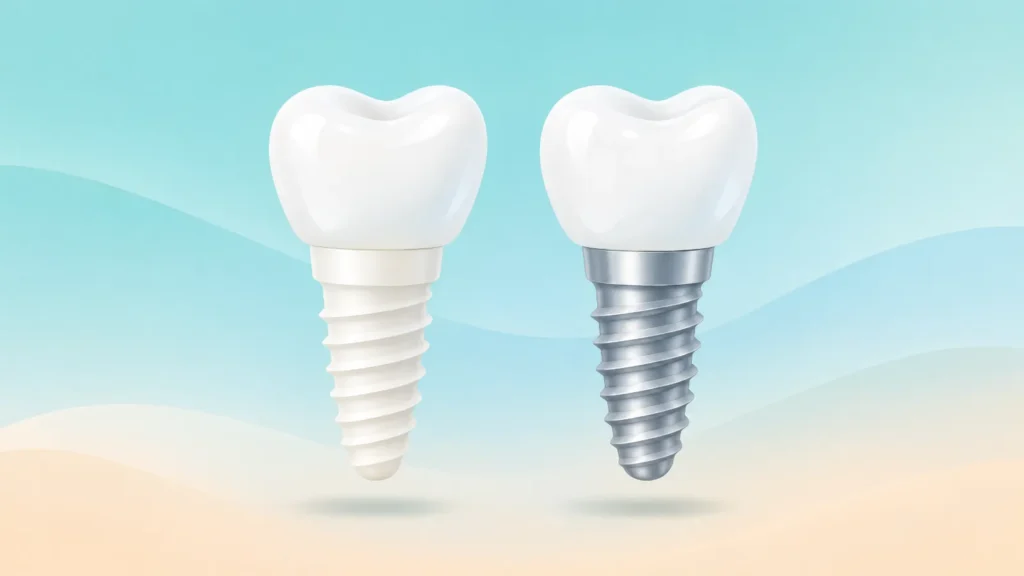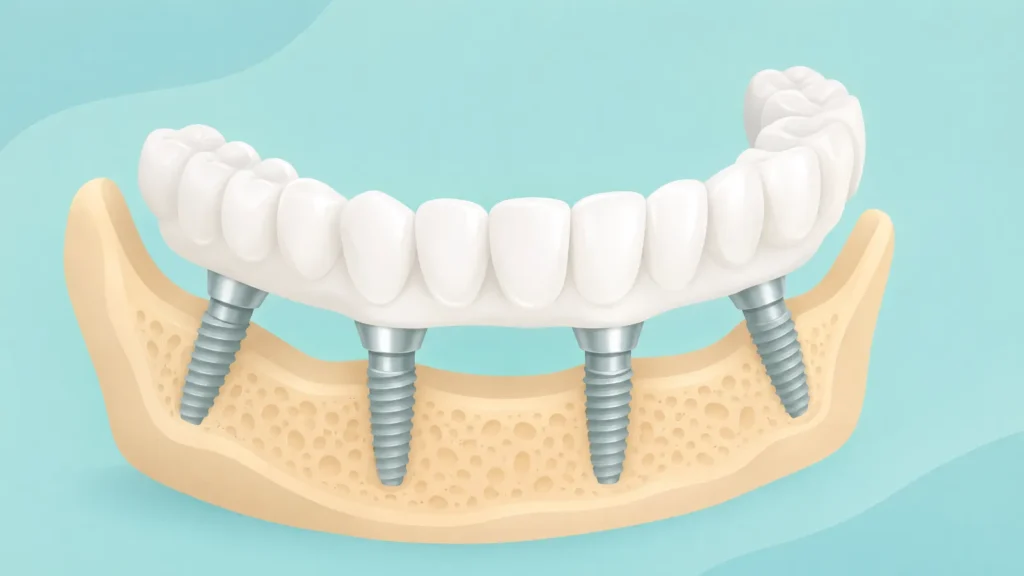
A mini dental implant is a narrower version of the standard post set into the jawbone. The FDA, AAP, AAOMS and ADA patient pages do not treat it as a separate type. Any implant needs surgery and enough bone, and AAOMS (updated September 2026) says bone grows onto an implant over several months. Your surgeon picks the width from imaging.
So the useful comparison is not mini versus traditional in the abstract. It is why your dentist proposes a particular width for your mouth, what the plan does about bone, and what the restoration on top will be. Below is what the official sources say, and the questions that separate a sound plan from an ad.
What do “mini” and “traditional” implants mean?
The FDA describes an implant system as an implant body placed in the jawbone in place of the tooth root, plus an abutment, usually held by a small screw, that extends through the gums to support the artificial tooth. The AAP groups implants by where they sit: endosteal implants go into the jawbone and are the most common type, while subperiosteal implants sit on top of the jaw with posts through the gum, generally for people who cannot wear conventional dentures and lack the bone height for an endosteal implant.
| Term | What it means | Where the definition comes from |
|---|---|---|
| Endosteal implant | A post placed in the jawbone that holds one or more teeth | AAP, the most common type |
| Subperiosteal implant | A framework on top of the jaw with posts through the gum | AAP |
| Abutment | The connector between the implant body and the artificial tooth | FDA |
| Osseointegration | The implant fusing with the surrounding bone over several months | AAOMS |
| “Traditional” implant | Usually a standard-width endosteal implant | Common usage, not an official category |
| “Mini” implant | A narrower fixture, a term used by manufacturers and practices | Not defined on the FDA, AAP, AAOMS or ADA patient pages cited here |
Because none of those pages sets a diameter for “mini” or publishes a separate success rate for narrow implants, treat any precise figure in an ad as a claim to ask about, not a fact.
The regulatory picture is the same for both. The FDA’s device classification database lists root-form endosseous implants as Class II devices that go through premarket notification, known as 510(k). The FDA consumer page says implant systems are evaluated against ISO or ASTM consensus standards, including biocompatibility testing, and that makers must show their systems are as safe and as effective as systems already on the U.S. market.
Why might a dentist suggest a narrower implant?
The patient pages cited here do not list reasons, so ask your dentist directly and get the answer in writing. The reasons that matter most for you are clinical ones tied to your imaging, such as how wide and tall the bone is where the implant would go and what the implant has to support.
Bone is central to the decision. The AAP says a key to implant success is the quantity and quality of the bone where the implant goes. When bone is short, the AAP describes ridge modification, which fills missing bone with bone or a bone substitute, and sinus augmentation for the upper back jaw, where bone typically develops for 4 to 12 months before implants go in. AAOMS says graft healing varies from procedure to procedure and patient to patient.
That makes these the questions to ask about any proposed width:
- Is a narrower fixture proposed because of my bone width, to avoid a graft, to help hold a denture, or for cost?
- What would a standard-width plan with a graft look like, and how would the timeline and total compare?
- How many implants will support the restoration, and why that number?
- What is the brand and model of the system? The FDA advises asking and keeping the record.
Dentures are a common reason the topic comes up. ADA MouthHealthy explains that an overdenture can fit over a few remaining natural teeth for stability, and that implants can serve the same supporting function. Our implant versus denture comparison covers that choice in more detail.
Who qualifies for either type?
Candidacy does not change with implant width. The AAP describes the ideal candidate as having good general and oral health, adequate bone in the jaw and gums free of periodontal disease. ADA MouthHealthy says your health is more of a factor than your age, that a physician may evaluate you before surgery, and that chronic illnesses such as diabetes or leukemia may interfere with healing.
The FDA adds that implant failure from infection may be more likely with uncontrolled diabetes, and from delayed healing may be more likely in people who smoke. Your dentist or oral surgeon decides whether any of these needs treatment first. Our guide to red flags for implant surgery goes through the common limits.
How long does healing take with either type?
The biology is the same for any implant set in bone. AAOMS says the crown, bridge or implant-supported denture goes on only once the implant has fully bonded and the gum tissue has matured. The stages below come from AAOMS and the AAP, and they apply to any width.
| Stage | Time named by the source | Source |
|---|---|---|
| Sinus augmentation, if the upper back jaw needs bone | Bone typically develops for 4 to 12 months before implants | AAP |
| Bone and soft tissue begin to heal | First few days to weeks | AAOMS |
| New bone grows onto the implant | Several months; 2 to 6 months in full-mouth cases | AAOMS, AAP |
| Gums heal after the abutments go on | A couple of weeks (full-mouth cases) | AAP |
| Final crown, bridge or denture | After full bonding and gum healing | AAOMS |
Some patients move faster. ADA MouthHealthy notes that some people get implants and replacement teeth in one visit, while others wait up to several months for full integration. That is a case-by-case decision for any implant, so a one-visit promise on its own is not a reason to choose a narrow fixture.
To build your own calendar, add the steps your surgeon gives you. Say, with made-up figures, a plan needs a 3-month graft, then 4 months of bone fusion, then 2 weeks of gum healing before the crown. That comes to 3 + 4 = 7 months plus 2 weeks. If the surgeon says a narrower fixture could skip the graft, the same plan would be 4 months plus 2 weeks, and the real question becomes whether skipping the graft is sound for your bone. Our dental implant procedure walkthrough explains each visit.
What do mini implant ads leave out?
Ads in this space tend to lead with a per-post price and a short calendar. The table compares common ad claims with what the cited sources say.
| Ad claim | What the sources say |
|---|---|
| No bone graft needed | The AAP lists adequate jawbone as part of the ideal candidate profile and calls bone quantity and quality a key to success. Whether a graft is needed is a judgment made on your imaging. |
| Heals in days | AAOMS says early tissue healing takes days to weeks, but bone attaches to the implant over several months. |
| Teeth in one visit | Some patients with any implant type get teeth the same day, while others wait months (ADA MouthHealthy). |
| Barely any surgery | Every implant body is placed in the jawbone (FDA), and AAOMS says some discomfort, swelling and bruising afterward is normal. |
| Half the price | No federal fee schedule exists to check that against, and Medicare.gov says Medicare generally does not cover implants. Compare itemized written quotes. |
Upkeep is the other piece ads skip. The AAP says implants need conscientious home care and regular dental visits, and its peri-implant disease page says inflammation that reaches the bone around an implant usually requires surgical treatment. It lists past gum disease, poor plaque control, smoking and diabetes as risk factors.
What are the trade-offs, and when is waiting the better choice?
The FDA lists benefits that apply to implants generally: restoring chewing and appearance, helping keep the jawbone from shrinking, and helping keep nearby teeth stable. AAOMS says that, unlike fixed bridges or removable dentures, implants likely will not affect neighboring healthy teeth or lead to bone loss in the jaw.
The risks also apply to every width. The FDA lists damage to nearby teeth during placement, injuries such as sinus perforation or jaw fracture, a bite that does not feel right, abutment screw loosening, implant failure from infection or delayed healing, and numbness from nerve damage. It says failure is usually defined as looseness or loss of the implant and may require another surgery.
Waiting, or another option, can make more sense in these situations:
- Untreated gum disease. The AAP’s ideal candidate has gums free of periodontal disease, so treatment comes first.
- Diabetes that is not under control. The FDA links uncontrolled diabetes with a higher chance of infection-related failure.
- Smoking. The FDA says smoking may affect healing and long-term success.
- Financing you cannot clear in time. A deferred-interest balance that outlasts your budget can cost more than the difference between two implant plans.
- A better fit elsewhere. A conventional bridge or denture may suit your health or budget for now.
How are mini implants marketed?
Across 18 years in finance and insurance performance marketing, I have seen health offers lead with the smallest number in the plan, and a per-post price for a narrow implant is a clear case. Before comparing quotes, ask what the advertised price leaves out:
- The exam, X-rays and 3D imaging
- Extractions and any bone graft
- Abutments and the final crown or denture
- Sedation, if you choose it
- Later repair or replacement of the crown or denture
Financing is often offered on the spot. The CFPB says a doctor or staff member generally signs you up for a medical credit card, that interest is often deferred, and that if the balance is not paid by the end of the promotion, interest accrues on the full amount charged.
Say a made-up $4,000 charge goes on a 12-month deferred-interest plan and you pay $300 a month.
| Example item (made-up figures) | Amount |
|---|---|
| Charged to the card | $4,000 |
| Paid after 12 payments of $300 | $3,600 |
| Still owed when the promotion ends | $400 |
| Deferred interest added at 26.99 percent | About $634 |
The CFPB says this interest is usually calculated on each month’s balance since the purchase. Those balances run from $4,000 down to $700 and add up to $28,200. At the 26.99 percent medical card rate cited in a 2023 CFPB report, $28,200 times 0.2699 divided by 12 is about $634 in interest on top of the $400. Our guide to what implant quotes include shows how to compare plans line by line first.
Questions to ask your dentist or oral surgeon
Add these to the width questions earlier in this guide:
- Based on my X-rays and 3D imaging, which width and which restoration do you recommend?
- Do gum disease, decay or diabetes need treatment before surgery is booked?
- Can I have the full calendar, from first procedure to final tooth, in writing?
- Does the itemized plan list every stage, including abutments and the final restoration?
- If I finance, is the interest deferred, and what happens to a balance left when the promotion ends?
- If this is a full arch, how does it compare with other full-arch options? Our guide to full-arch implant options lays them out, and a second opinion is worth getting.
Frequently asked questions
Are mini dental implants FDA approved?
The FDA’s classification database lists root-form endosseous implants as Class II devices that go through 510(k) premarket notification, and the FDA says makers must show a system is as safe and as effective as systems already on the U.S. market. Ask your provider for the brand and model used and keep that record.
Do mini implants let you skip a bone graft?
Not automatically. The AAP calls the quantity and quality of bone a key to implant success, and AAOMS says graft healing varies by procedure and patient. Whether a narrower fixture can be used instead of a graft is a judgment your dentist or oral surgeon makes from your imaging.
How long does healing take with either type?
AAOMS says tissues begin to heal within days to weeks and bone attaches to the implant over several months. For full-mouth implants, the AAP describes 2 to 6 months of bonding. Some patients get teeth the same day, but that is decided case by case.
Does Medicare cover mini or traditional implants?
Generally no. Medicare.gov says Medicare does not cover items like dentures and implants, with narrow exceptions for dental care tied to certain covered medical treatment. Check any dental or Medicare Advantage plan in writing before treatment.
Can I get an MRI or X-ray if I have implants?
Yes, but tell the imaging staff first, because the FDA says implants can distort or interfere with images. The FDA says it is not aware of adverse events reported for MRI or X-ray procedures with dental implants.

Review status: Not yet reviewed by a dentist. This guide is general information, not medical advice.
Sources
- FDA: Dental Implants: What You Should Know
- FDA: Product Classification, implant, endosseous, root-form (21 CFR 872.3640)
- American Academy of Periodontology (professional association): Dental Implant Procedures
- American Academy of Periodontology (professional association): Full Mouth Dental Implants
- American Academy of Periodontology (professional association): Sinus Augmentation
- American Academy of Periodontology (professional association): Peri-Implant Diseases
- AAOMS (professional association): Healing Process for Dental Implants
- AAOMS (professional association): Dental Implant Surgery
- AAOMS (professional association): Bone Grafts
- American Dental Association, MouthHealthy (professional association): Implants
- American Dental Association, MouthHealthy (professional association): Dentures
- Medicare.gov: Dental services
- CFPB: What should I know about medical credit cards and payment plans for medical bills?
- CFPB: What is a deferred interest promotion?
- CFPB: Report highlights costly credit cards and loans pushed on patients (May 2023)
- IRS: Publication 502, Medical and Dental Expenses (2025 returns)
- IRS: Publication 969, Health Savings Accounts and Other Tax-Favored Health Plans (2025 returns)