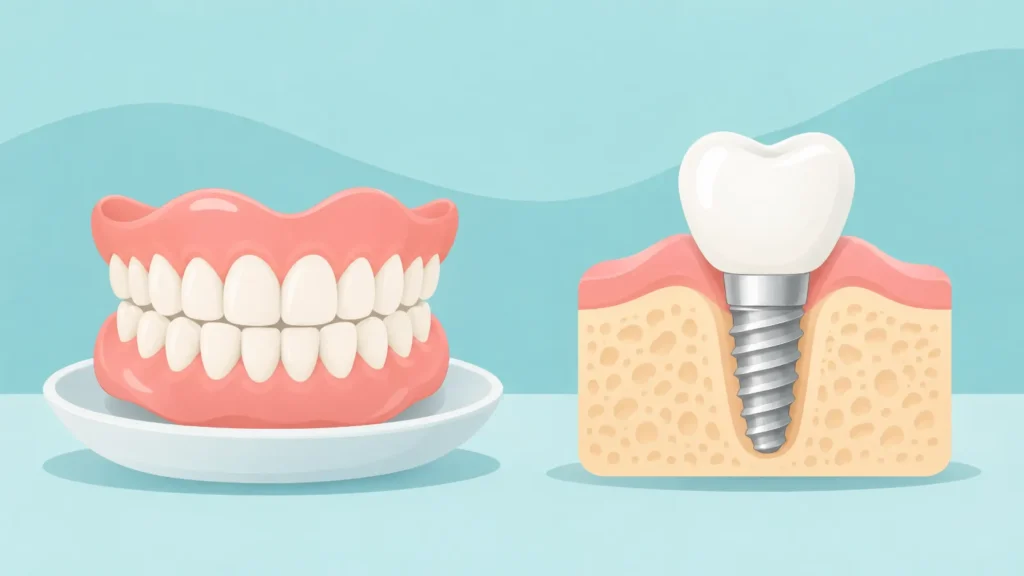
Conventional dentures rest on the gums, skip implant surgery and usually cost less upfront, but the jawbone under them keeps shrinking. Implants anchor in the bone, hold teeth steadier and help preserve it, but they need surgery, months of healing and enough bone. NIDCR reports about 15 percent of adults 65 and older had no natural teeth in 2017 to 2020.
Which one fits depends on your bone, gums, general health and budget, and on how you feel about taking your teeth out every night. A licensed dentist or oral surgeon has to examine your mouth, health history and imaging before anyone can say which suits you. This guide lays out the trade-offs and the questions to bring to that visit.
What is the difference between a denture, an implant and an implant-supported denture?
Ads blur these terms. Pin them down before you compare quotes or timelines, because each one carries a different price, schedule and daily routine.
- Conventional full denture. ADA MouthHealthy says it is made and placed after the remaining teeth are removed and the tissues have healed, which may take several months.
- Immediate denture. Inserted the same day the remaining teeth come out. MouthHealthy notes it may need to be relined or remade after the jaw heals.
- Overdenture. A denture that fits over a few remaining natural teeth, which add stability. MouthHealthy says implants can serve the same supporting function.
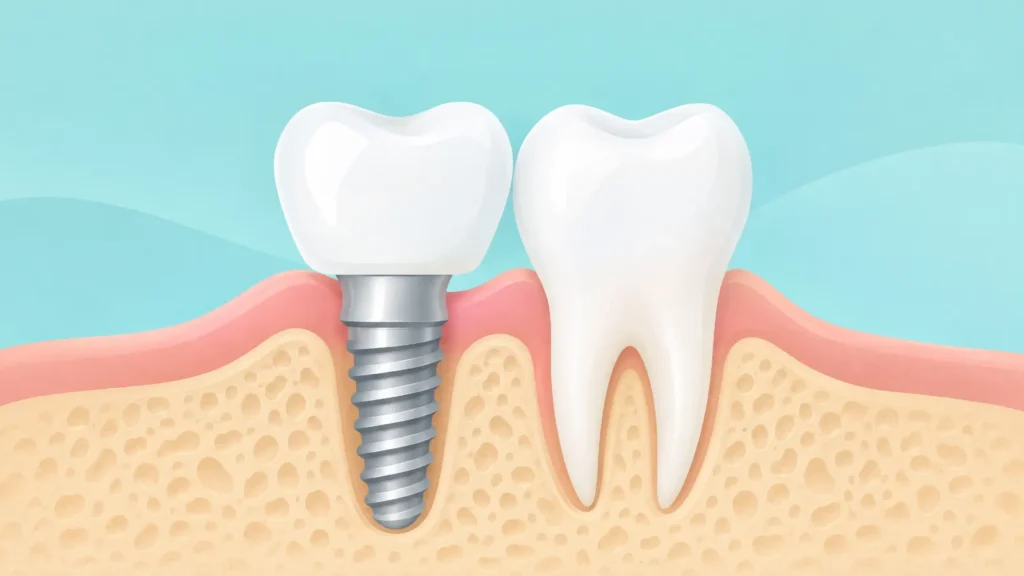
- Dental implant. The FDA describes an implant body placed in the jawbone where the root used to be, plus an abutment that extends through the gums to hold the artificial tooth. Most systems are titanium or zirconium oxide.
- Removable implant-supported denture. A denture that attaches to implants for stability but still comes out for cleaning.
- Fixed full-arch bridge on implants. A full arch attached to implants that you do not remove at home. The AAP describes full bridges or dentures attached to abutments after the implants bond with the bone.
| Option | How it stays in place | Implant surgery | Daily care |
|---|---|---|---|
| Conventional full denture | Rests on the gums | No | Remove and clean after eating, soak overnight |
| Removable implant-supported denture | Attaches to implants | Yes | Remove to clean the denture, plus brushing around the implants |
| Fixed full-arch bridge on implants | Attached to implants | Yes | Daily brushing and flossing, regular dental visits |
| Single implants with crowns | Each crown on its own implant | Yes | Daily brushing and flossing, regular dental visits |
The care column follows the AAP full-mouth implant page, which says conventional dentures should be removed and cleaned after eating and soaked overnight, while implants are cared for with daily brushing and flossing.
How do implants and dentures compare on bone, chewing and stability?
Bone is the biggest difference, and the one patients hear about least. The AAP says that with conventional dentures, the bone that surrounded the tooth roots begins to deteriorate, which leads to recession of the jawbone. Because full-mouth implants replace some of the roots and integrate with the jawbone, the AAP says more of that bone is preserved. The FDA likewise lists helping prevent jawbone shrinkage among the benefits of implants.
Stability comes next. AAOMS says osseointegration, the bone fusing to the implant, is what makes implant restorations stable, unlike conventional removable dentures. The AAP adds that full-mouth implants are more comfortable and stable than conventional dentures, allow more natural biting and chewing, and make some foods easier to eat.
For people replacing one or a few teeth rather than a full arch, AAOMS says implants likely will not affect neighboring healthy teeth or lead to bone loss in the jaw, unlike fixed bridges or removable dentures. How much difference you notice depends on your bone and the prosthesis your dentist designs, so treat these as general advantages rather than a promise.
Who is a good candidate for implants instead of dentures?
The AAP describes the ideal implant candidate as someone with good general and oral health, enough bone in the jaw to support the implant, and gums free of periodontal disease. ADA MouthHealthy says your health is more of a factor than your age, that chronic illnesses such as diabetes or leukemia may interfere with healing, and that tobacco can slow it.
The FDA adds that smoking may affect healing and lower long-term success, and that implant failure from infection may be more likely in patients with uncontrolled diabetes. None of these automatically rules implants out. Your dentist or oral surgeon decides whether to treat a condition first, add a bone graft or recommend a denture, based on your own exam. Our guide to conditions that can rule out implants covers these limits in more depth.
This is a common choice later in life. NIDCR data from the 2017 to March 2020 national survey show 15.2 percent of adults 65 and older had no remaining teeth: 11.4 percent of those 65 to 74 and 19.7 percent of those 75 and older. Among current smokers 65 and older the figure was 29.4 percent, compared with 11.9 percent of those who never smoked. NIDCR notes that cycle was partly disrupted by COVID-19, so compare it with earlier years carefully.
How long does each option take?
A conventional denture skips implant surgery and bone fusion, but it still waits on healing. ADA MouthHealthy says a conventional denture goes in after the remaining teeth are removed and the tissues heal, which may take several months. An immediate denture goes in the same day, with a likely reline or remake once the jaw settles.
An implant-supported arch follows a longer sequence. The AAP full-mouth page describes five steps:
| Step | What happens | Timing (AAP full-mouth page) |
|---|---|---|
| 1 | Implants placed, with temporary teeth or healing caps over them | Day of surgery |
| 2 | Stitches removed | 7 to 10 days later |
| 3 | Implants and bone bond together | About 2 to 6 months |
| 4 | Implants uncovered and abutments attached | Then a couple of weeks of gum healing |
| 5 | Final full bridge or denture attached | After the gums heal |
Bone work can come first. AAOMS says bone graft healing varies from procedure to procedure and patient to patient, and the AAP says bone typically develops for 4 to 12 months after a sinus augmentation before implants go in.
Say a surgeon expects a graft to need 4 months before the implants, using made-up figures to show the math. Adding the AAP’s 2 to 6 months of bonding gives 4 + 2 = 6 months at the short end and 4 + 6 = 10 months at the long end, plus about two weeks of gum healing before the final arch. Your own surgeon’s estimates replace these numbers.
Some patients move faster. ADA MouthHealthy notes that some people can have implants and replacement teeth placed in one visit, while others wait up to several months for full integration. Your bone and health decide which path is realistic, and our guide to how implants are placed walks through each visit.
What does daily care look like with each option?
Say someone with a conventional denture eats three meals a day. Following the AAP advice to remove and clean the denture after eating means 3 cleanings a day, or 21 a week, plus 7 overnight soaks. MouthHealthy adds brushing the denture with a soft brush, storing it in water so it does not warp, and brushing your gums, tongue and palate each morning. New dentures may feel awkward for a few weeks.
A fixed implant arch skips that routine but does not remove the work. The AAP says implants need conscientious home care and regular dental visits. Its page on peri-implant diseases explains that gum inflammation around an implant may be reversible if caught early, but peri-implantitis, which involves bone loss, usually requires surgical treatment. It lists past gum disease, poor plaque control, smoking and diabetes as risk factors.
How do the costs compare over time?
No federal agency publishes national prices for either option, so the only real comparison is between written quotes for your mouth.
The upfront gap is only part of the picture. AAOMS says fixed bridges and dentures may cost less at first but carry ongoing upkeep, with some needing replacement every 7 to 15 years. Over 21 years, a denture remade every 7 years means 3 dentures (21 divided by 7), while one that lasts 15 years means 2: the original and one replacement. Ask your dentist how often relines and remakes happen for the denture they propose, and how long the crown or bridge on an implant is expected to last.
Our guide to dental implant prices shows how a full-arch plan is itemized, line by line.
When is a denture, or waiting, the better fit?
| Option | Main benefits | Main downsides |
|---|---|---|
| Conventional denture | No implant surgery, lower upfront cost, an option when health rules out surgery | May feel loose or awkward at first; bone under it keeps deteriorating, so fit changes; daily removal and soaking |
| Implant-supported denture or arch | More stable chewing, better bone preservation, no overnight soaking with a fixed arch | Surgery and months of healing; candidacy limits; implant failure may need another surgery, per the FDA; higher upfront cost |
A conventional denture, or a pause before implants, can make sense when gum disease or diabetes needs treatment first, when a graft would add months you cannot commit to, or when surgery is not advisable for your health. An immediate or conventional denture can also serve as a step while you decide, since MouthHealthy notes implants can later support an overdenture. Whether you still have enough bone for that later step is something your dentist checks on imaging.
How are implant and denture offers sold?
In 18 years of finance and insurance performance marketing, I have watched full-arch implant ads lead with a monthly payment instead of a total. A monthly figure says nothing about grafting, extractions, the healing denture or what happens if an implant fails.
The CFPB says medical credit cards often use deferred interest, with rates upwards of 25 percent in some cases, and that if the balance is not paid by the end of the promotion, interest accrues on the full amount charged. It also warns that skipping a second opinion can lead to more expensive treatment than you need. Before you sign, ask for the full written plan and the brand and model of the implant system, which the FDA suggests keeping for your records.
Questions to ask your dentist or oral surgeon
- Do my bone, gums and health support implants, and would I need a graft or gum treatment first?
- What does each option’s written plan include, from extractions and healing dentures to the final prosthesis?
- How many months will each take, including the range if grafting or slow healing adds time?
- What upkeep should I expect, such as relines, remakes, cleanings and checkups, and how often?
- What does my coverage pay toward dentures, implants and each related line, in writing?
- Should I get a second opinion before a full-arch plan? The full-arch options guide explains the designs you may be offered.
Frequently asked questions
Are implants or dentures better for chewing?
General clinical sources describe implants as more stable. The AAP says full-mouth implants are more comfortable and stable than conventional dentures and let people bite and chew more naturally. How much difference you notice depends on your bone and the prosthesis your dentist recommends.
Do dentures cause bone loss?
The AAP says that with conventional dentures, the bone that surrounded the tooth roots begins to deteriorate, which leads to recession of the jawbone over time. Implants integrate with the bone and help preserve it, according to the AAP and the FDA.
Can I switch from dentures to implants later?
Often, but bone loss under a denture can make it harder. AAOMS says bone grafts can rebuild bone for implants, with healing that varies by procedure and patient. Your dentist or oral surgeon can check on imaging whether you still have enough bone.
Does Medicare pay for dentures or implants?
Generally no. Medicare.gov says Medicare does not cover items like dentures and implants, except for narrow cases tied to certain covered medical treatment. Some Medicare Advantage plans and state Medicaid programs include dental benefits, so ask your plan in writing.
Am I too old for dental implants?
Age alone is rarely the deciding factor. ADA MouthHealthy says your health is more of a factor than your age, and that chronic illnesses such as diabetes, and tobacco use, can slow healing. Your dentist may ask a physician to evaluate you first.

Review status: Not yet reviewed by a dentist. This guide is general information, not medical advice.
Sources
- American Academy of Periodontology (professional association): Full Mouth Dental Implants
- American Academy of Periodontology (professional association): Dental Implant Procedures
- American Academy of Periodontology (professional association): Sinus Augmentation
- American Academy of Periodontology (professional association): Peri-Implant Diseases
- AAOMS (professional association): Dental Implant Surgery
- AAOMS (professional association): Bone Grafts
- AAOMS (professional association): How Much are Dental Implants?
- American Dental Association, MouthHealthy (professional association): Implants
- American Dental Association, MouthHealthy (professional association): Dentures
- FDA: Dental Implants: What You Should Know
- NIDCR: Tooth Loss in Seniors (Age 65 and Over)
- Medicare.gov: Dental services
- Medicaid.gov: Dental Care
- CFPB: What should I know about medical credit cards and payment plans for medical bills?