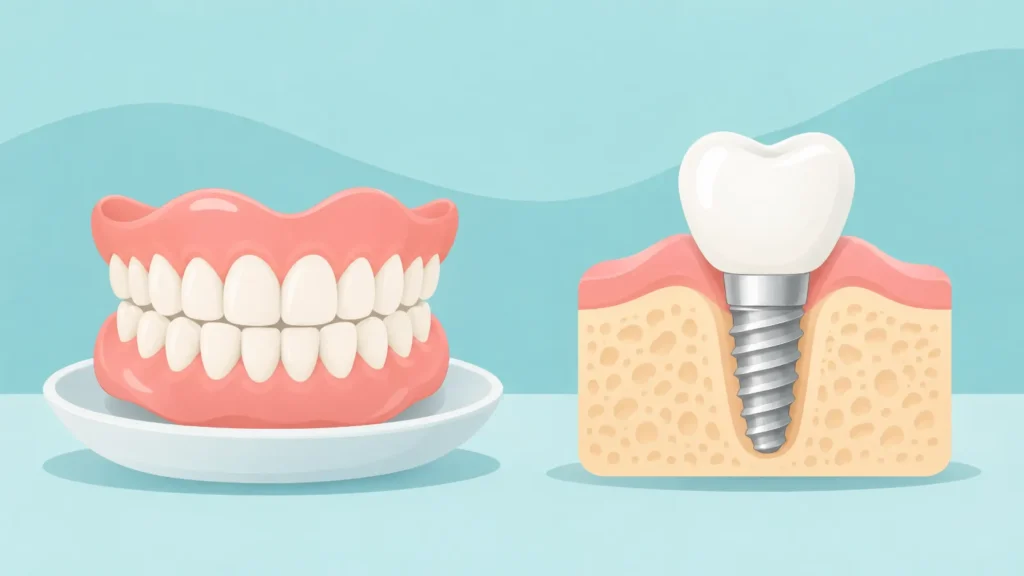
A dental implant is a post, usually titanium, that a surgeon places in the jawbone to replace a tooth root, with a crown, bridge or denture attached on top. Treatment usually takes several months while the bone fuses to the post, and AAOMS, the oral surgeons’ professional association, puts the overall success rate at about 95 percent (page updated 2026).
That success figure comes from a professional association, not a government agency, and it describes implants placed by oral and maxillofacial surgeons. Your own odds depend on your bone, your gums and your general health, and your dentist or oral surgeon decides whether implants fit your mouth after an exam and imaging. What follows is the groundwork for that first consult: the parts, the stages, who tends to qualify, what can go wrong, and how the bill is usually built.
What is a dental implant, and what do the key terms mean?
The FDA describes dental implants as medical devices placed in the jaw to restore chewing or appearance by supporting a crown, bridge or denture. A system has an implant body, which takes the place of the tooth root, and an abutment, usually held by a small screw, that comes up through the gums to hold the new tooth.
| Term | What it means |
|---|---|
| Implant body (post) | The part placed in the jawbone where the tooth root used to be |
| Abutment | The connector that extends through the gums and holds the replacement tooth |
| Restoration | The visible tooth: a single crown, a bridge, or an implant-supported denture |
| Osseointegration | The jawbone growing around and bonding with the implant |
| Bone graft | Bone or a bone substitute added where the jaw is too thin or too short to hold an implant |
| Endosteal implant | The most common type, placed inside the jawbone |
| Subperiosteal implant | A design that sits on top of the jaw, under the gum, with posts that come through the gum |
The American Academy of Periodontology (AAP), a professional association of gum specialists, says subperiosteal implants are generally used for people who cannot wear conventional dentures and who lack the bone height for an endosteal implant. Endosteal implants can hold one or more teeth and are often an option for people who already wear bridges or removable dentures.
The FDA says most implant systems are made of titanium or zirconium oxide, with gold alloys, cobalt-based alloys, titanium alloys and ceramics used at times, and that the materials follow international consensus standards. Before a system can be sold in the U.S., the maker must show the FDA that it is as safe and effective as systems already on the market. The FDA also suggests asking which brand and model your surgeon uses and keeping that record with your dental files.
How long does the dental implant process take?
Most of the calendar is healing time, not chair time. The American Dental Association’s MouthHealthy site describes three phases, and the table adds the published timing for each.
| Phase | What happens | Published timing |
|---|---|---|
| Before surgery, if needed | A bone graft or sinus augmentation builds up thin or short bone | Varies by site and patient (AAOMS); a sinus graft integrates over a few months |
| 1. Placement | The implant is surgically placed in the jawbone | One visit |
| 2. Healing | Bone grows around and bonds with the implant | Up to several months (MouthHealthy); up to a few months (AAOMS); several months or longer (FDA) |
| 3. Restoration | The crown, bridge or denture is attached, sometimes after a temporary one | After healing; sooner with immediate loading when bone allows (AAOMS) |
No source gives one fixed number for the healing step. AAOMS says full osseointegration can take up to a few months, and the FDA says healing may take several months or longer. The pace depends on the site, the bone and the patient.
Some plans add a stage at the start. AAOMS describes bone grafting as a way to provide enough good-quality bone at the site, using the patient’s own bone, donor bone, animal-derived bone or a synthetic material, and says healing varies with the donor site, the site being treated and the patient’s overall health. For upper back teeth, a sinus augmentation raises the sinus floor and adds bone, and AAOMS says that graft integrates over the next few months before implants are placed if they were not placed at the same time.
Other plans shorten the wait. AAOMS says patients with enough bone may qualify for immediate loading, where temporary or permanent teeth go on at or soon after surgery. A temporary tooth placed on the day of surgery mainly for appearance should not be used for chewing or biting, according to the same page. For each visit in order, see the step-by-step implant procedure guide.
What tends to set the pace
| Factor | Why it matters |
|---|---|
| Bone volume | Thin or short bone may need a graft or sinus augmentation before the implant (AAOMS, AAP) |
| Gum health | AAP describes ideal candidates as having healthy gums free of periodontal disease |
| Smoking | The FDA says smoking can impair healing and reduce long-term success |
| Diabetes | NIDCR says diabetes can slow healing, and the FDA links uncontrolled diabetes with infection-related failure |
| Bone quality at surgery | Immediate loading is only offered when the bone can support the implant right away (AAOMS) |
Who is usually a good candidate?
AAP describes ideal candidates as people in good general and oral health who have enough jawbone to support the implant and healthy gums free of periodontal disease. ADA’s MouthHealthy adds that general health matters more than age, that you may need a physician’s evaluation before surgery, and that chronic illnesses such as diabetes or leukemia may interfere with healing.
There is no single cutoff age in the sources checked for this guide. AAOMS says most patients are candidates regardless of age, with growing children as the exception because their teeth and jaws are still developing, and its patient guide says implant treatment in children is usually put off until jaw growth is complete. Whether your jaw has finished growing is something your dentist or oral surgeon judges from your exam and imaging.
Smoking comes up at nearly every consult. The FDA says it can impair healing and reduce long-term success, and the AAOMS patient guide says smoking lowers the success rate of implants but does not rule them out. For context on smoking and tooth loss in general, NIDCR survey data for 2017 to March 2020 show 7.6% of current smokers ages 20 to 64 had no natural teeth left, compared with 0.3% of people who never smoked.
Gum disease matters too, and it is common. NIDCR reports that 42.2% of U.S. adults ages 30 and older had periodontitis in national survey data from 2009 to 2014. AAP lists a past diagnosis of gum disease as a risk factor for disease around implants, which is why gum treatment often comes before implant surgery. The conditions that can delay or rule out treatment are covered in more depth in our dental implant candidacy guide.
What are the main risks?
The FDA lists the following risks and complications. Some can happen during or soon after surgery, and others can show up much later.
| Risk | What it can look like |
|---|---|
| Damage to nearby teeth | Injury to natural teeth next to the implant site during placement |
| Surgical injury | A perforated sinus or a fractured jawbone |
| Screw or bite problems | Poor bite, or a feeling that the tooth is loose or twisting, sometimes from a loosened abutment screw |
| Nerve effects | Numbness from pressure on or damage to a nerve |
| Implant failure | Looseness of the implant body, which can follow infection or delayed healing |
| Cleaning problems | Difficulty cleaning around the implant, and untreated gum disease |
AAOMS separates two kinds of failure on its page about whether implants are permanent. Short-term failure usually means the bone did not heal around the implant, with signs such as mobility, pain and bleeding, and may call for removal, a bone graft, healing time and a new implant. Long-term failure happens after healing, and its most common cause is peri-implantitis, a chronic infection of the gum and bone around the implant. AAOMS lists low bone density, uncontrolled diabetes and smoking as risk factors for short-term failure.
AAP explains that peri-implant disease starts as mucositis, inflammation of the soft gum tissue only, which may be reversible if it is caught early. Peri-implantitis also involves loss of the supporting bone and usually needs surgical treatment.
How do implants compare with a bridge or dentures?
| Option | Main benefit | Main trade-off |
|---|---|---|
| Single implant with crown | The FDA says implants help preserve jawbone and gum health and keep nearby teeth stable | Surgery, months of healing, enough bone, and ongoing risk of disease around the implant |
| Tooth-supported bridge | No implant surgery | It is anchored by crowns on the teeth beside the gap (MedlinePlus), and AAOMS says bridges may need replacing every 7 to 15 years |
| Removable dentures | No implant surgery | AAOMS says traditional dentures may need replacing every 7 to 15 years and can slip or make noise, which implants do not |
NIDCR’s 2021 report, Oral Health in America, says implant use among adults 65 and older rose from about 1% to more than 7% since 2000, and that implants are becoming the preferred treatment for many older adults who can afford them. The same report says implant procedures remain costly and out of reach for most adults, which is why the comparison above is often a budget question as much as a clinical one.
Do dental implants last forever?
The post can last a very long time. AAOMS and AAP both say an implant can last a lifetime with proper care, but neither promises it, and AAOMS notes that implants can fail. The tooth on top is a separate part with its own lifespan. MedlinePlus says most dental crowns last at least 5 years and some last 15 to 20 years; that figure covers crowns in general, not implant crowns alone.
An implant also is not immune to gum and bone problems. NIDCR’s 2021 report says implant success rates are among the highest of any type of surgical implant, but it also raises concern that peri-implantitis is increasing as more people get implants. The habits that sources agree on are simple:
- Brush and floss around implants as you would natural teeth (AAP).
- Follow the cleaning instructions your dental team gives you, since the FDA ties cleaning to long-term success.
- Keep regular dental visits so the implant, teeth and gums can be checked (FDA, AAP).
- Report loose, painful, red or bleeding areas early rather than waiting for the next checkup.
Lifespan, crown replacement and what shortens both are covered in our guide to implant longevity.
How are dental implants priced and sold?
No federal agency publishes a national implant fee schedule, and an advertised starting price for one implant is not a typical total. A full plan can include exams and imaging, an extraction, a graft, the implant, the abutment, the crown and sedation, and each can be billed as its own line.
In 18 years of finance and insurance performance marketing, I have seen starting prices used as the headline while the rest of the plan sits in the fine print. Ask for an itemized written quote that lists every stage and its fee, and compare totals rather than headlines. Our guide to how much dental implants cost walks through what a single-tooth quote and a full-mouth quote tend to include.
Financing is where costs can grow. The CFPB says medical credit cards often carry deferred interest: if any balance is left when the promotion ends, interest is charged on the full amount you originally charged, not just what remains, and rates can reach upwards of 25 percent in some cases.
Say a plan totals $8,000 on a deferred-interest card and you pay $7,500 before the promotion ends. Interest can be charged on the full $8,000 instead of the $500 left. At a 25 percent annual rate, one year of simple interest on $8,000 is $2,000, compared with $125 on $500. Real card terms vary and interest usually compounds, so treat this as arithmetic to show scale, not a quote.
| Hypothetical $8,000 plan | Amount interest is figured on | One year of simple interest at 25% |
|---|---|---|
| Deferred interest, $500 left at the deadline | $8,000 | $2,000 |
| Interest only on what is left | $500 | $125 |
Questions to ask your dentist or oral surgeon
- Do my X-rays and 3D images show enough bone? If not, would a graft happen before the implant or in the same surgery?
- How do my health and medicines affect healing? Bring a list of every medicine and supplement, and mention any condition such as diabetes.
- Can I have an itemized written plan? It should list each stage, its fee and the expected healing time between stages.
- Which implant brand and model will you use? The FDA suggests keeping this with your records.
- Would a second opinion make sense here? It matters most for full-arch work with several implants.
- If I finance, when does interest start, and is it deferred? Get the terms and fees in writing, as the CFPB suggests.
- What should I plan for after surgery? Ask what you can eat in the first days, whether you will need a driver after sedation, and when follow-up visits happen. The guide to recovering from implant surgery covers the first weeks.
Frequently asked questions
Does dental implant surgery hurt?
AAOMS says some discomfort, swelling and bruising at the site are normal after surgery, and your surgeon may prescribe or recommend an over-the-counter pain reliever. Ask before surgery which anesthesia or sedation options are offered.
How old do you need to be to get an implant?
The sources checked for this guide set no single age. AAOMS says growing children are the exception because their jaws are still developing, so treatment is usually put off until jaw growth is complete, and your dentist or oral surgeon judges that.
Can I get new teeth the same day?
Sometimes. ADA’s MouthHealthy says some patients get implants and teeth in one visit, and AAOMS says immediate loading depends on having enough bone to support the implant right away.
Will Medicare pay for dental implants?
In most cases, no. Medicare.gov says it does not cover items like dentures and implants, with narrow exceptions tied to hospital stays or certain covered medical treatments.
What happens if an implant fails?
The FDA says failure usually means the implant loosens or comes out and may require another surgery. AAOMS says treatment can include removing the implant, a bone graft, healing time and a replacement implant.
Can an implant get gum disease?
Yes. AAP says bacteria can build up around an implant below the gum line, causing peri-implant mucositis and, if untreated, peri-implantitis with bone loss.

Review status: Not yet reviewed by a dentist. This guide is general information, not medical advice.
Sources
- AAOMS (professional association): Are Dental Implants Safe?
- FDA: Dental Implants: What You Should Know
- American Academy of Periodontology (professional association): Dental Implant Procedures
- American Dental Association (professional association), MouthHealthy: Implants
- AAOMS (professional association): How Do Dental Implants Work?
- AAOMS (professional association): Bone Grafting
- AAOMS (professional association): Sinus Augmentation
- AAOMS (professional association): Dental Implant Surgery patient guide (PDF)
- NIDCR: Tooth Loss in Adults (Age 20 to 64)
- NIDCR: Periodontal Disease in Adults (Age 30 or Older)
- AAOMS (professional association): Are Dental Implants Permanent?
- American Academy of Periodontology (professional association): Peri-Implant Diseases
- MedlinePlus: Dental crowns
- NIDCR: Oral Health in America, Executive Summary (2021)
- Medicare.gov: Dental services
- CFPB: What should I know about medical credit cards and payment plans for medical bills?