
The implant post can last a lifetime with proper care, according to AAOMS and the AAP, but the crown, bridge or denture on top wears on its own schedule. MedlinePlus says most dental crowns last at least 5 years and some last 15 to 20, and AAOMS says bridges and dentures may need replacing every 7 to 15 years.
So the honest answer comes in two parts: one for the artificial root in the bone, and one for the tooth you actually chew with. Neither comes with a guarantee. The FDA says your general health affects how long an implant may last and that smoking can reduce long-term success, and your dentist or oral surgeon is the one who can judge the factors in your own mouth.
Which parts of an implant are we talking about?
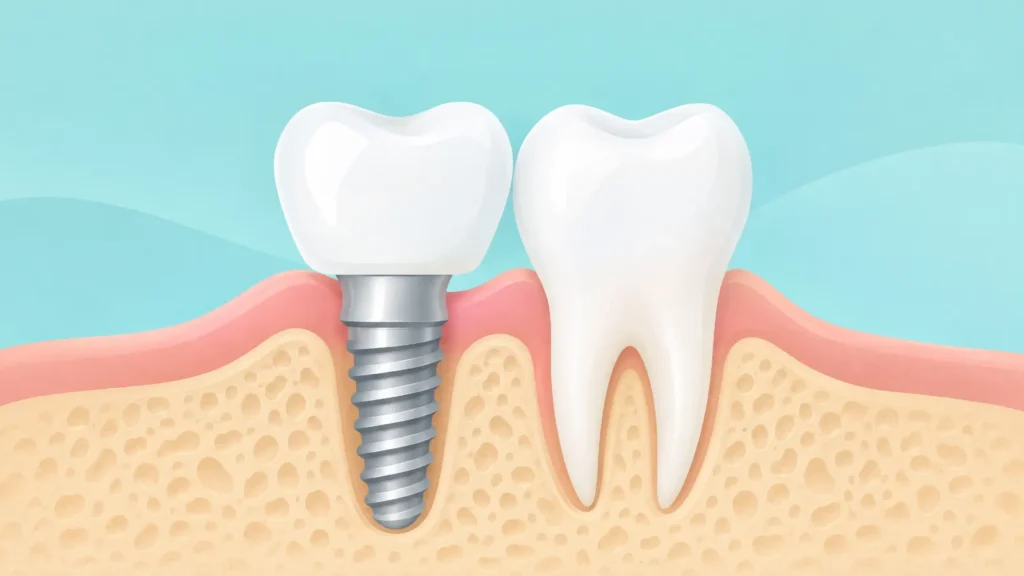
An implant is three parts that age at different rates. When an ad says implants last a lifetime, it is usually talking about the first one only.
| Part | What it is | What sets its lifespan |
|---|---|---|
| Implant body (post) | The piece in the jawbone, usually titanium or zirconium oxide (FDA) | Bone health, gum health, general health and smoking |
| Abutment and screw | The connector through the gum, usually held by a screw (FDA) | Screw loosening can cause a loose or twisting feeling (FDA) |
| Crown, bridge or denture | The visible tooth or teeth you chew with | Wear and breakage over time, like any restoration |
The basics of how the parts go in are covered in our dental implant basics for beginners.
What do the sources say about implant lifespan?
No source publishes one lifespan number that fits every patient. The table sets their statements side by side.
| Component | What the source says | Source |
|---|---|---|
| Implant post | Can last a lifetime when properly cared for | AAOMS; AAP |
| Implant post | Overall success rate of up to 95 percent (page updated 2026) | AAOMS |
| Implant post | General health affects how long it may last; smoking can reduce long-term success | FDA |
| Crowns in general | Most last at least 5 years; some last 15 to 20 years | MedlinePlus (2024 review) |
| Fixed bridges and traditional dentures | May need replacing every 7 to 15 years | AAOMS |
Two cautions on those numbers. The 95 percent figure comes from a professional association describing implants placed by oral and maxillofacial surgeons, not from a government study, and it does not say over how many years. The MedlinePlus crown range covers crowns in general, not crowns on implants alone, so ask your dentist what they expect for the material and position of yours.
NIDCR’s 2021 Oral Health in America report says improved materials, procedures and provider experience have given implants success rates among the highest of any type of surgical implant. It also says implant use among adults 65 and older rose from about 1% to more than 7% since 2000, and it raised concern that peri-implantitis is increasing as implants become more common.
Why do some implants fail early and others fail late?
AAOMS separates failure into two kinds on its page about whether implants are permanent.
- Short-term failure usually means the bone did not heal well around the implant. Signs include mobility, pain and bleeding, and treatment can mean removing the implant, placing a bone graft, waiting for healing and then placing a new implant. AAOMS lists low bone density, uncontrolled diabetes and smoking as risk factors.
- Long-term failure happens after the implant has integrated and healed. AAOMS says the most common cause is peri-implantitis, a chronic infection of the gum and bone, and that prosthetic problems such as a broken screw or loose abutment can also cause it.
The AAP says peri-implant disease begins as mucositis, inflammation limited to the gum, which may be reversible if caught early. Peri-implantitis adds loss of the supporting bone and usually needs surgical treatment. AAP lists a past diagnosis of gum disease, poor plaque control, smoking and diabetes as risk factors. The full list of warning signs and fixes is in our implant troubleshooting guide.
What shortens an implant’s working life?
Most of the factors the sources name are ones you and your dental team can work on.
- Smoking. The FDA says it can impair healing and reduce long-term success, and AAP lists it as a risk factor for peri-implant disease.
- Uncontrolled diabetes. The FDA links it with infection that can lead to failure, and NIDCR says diabetes can slow healing.
- Past or untreated gum disease. AAP lists a prior gum disease diagnosis as a risk factor, and NIDCR says tobacco is the most significant risk factor for gum disease.
- Poor plaque control. AAP names it directly, and the FDA lists difficulty cleaning around the implant as a risk.
- Loose parts. A loose or twisting feeling can come from the abutment screw, which the FDA says to report right away.
One common belief deserves to go: that an implant cannot fail because it cannot decay. None of the sources used here addresses decay in the implant or its crown, and AAP says bacteria can build up around an implant below the gum line and damage the bone if untreated. The risk to an implant sits in the gum and bone around it, which is why cleaning matters as much as it does for natural teeth.
How many crowns might one implant need?
Say an implant is placed at age 50 and the post stays healthy for 30 years, to age 80. The crown on top is the part that wears. Using the MedlinePlus range for crowns in general, the count changes a lot depending on where in that range yours falls.
| Crown lifespan | Crown replacements from age 50 to 80 | When they fall |
|---|---|---|
| 15 years | 1, with a second due at 80 | Age 65 |
| 10 years | 2, with a third due at 80 | Ages 60 and 70 |
| 5 years | 5, with a sixth due at 80 | Ages 55, 60, 65, 70 and 75 |
The arithmetic is 30 years divided by the crown’s lifespan, minus the original crown: 30 / 15 = 2 crowns in all, or 1 replacement; 30 / 10 = 3 crowns, or 2 replacements; 30 / 5 = 6 crowns, or 5 replacements. The surgery and bone healing happen once. Crown replacements are a repeat cost, and the table shows why it pays to ask about them before you agree to a plan. These figures illustrate the range; they are not a forecast for any one mouth.
How does an implant compare with a bridge or dentures over time?
| Option | Lifespan point from the sources | Trade-off |
|---|---|---|
| Implant with crown | Post can last a lifetime with care (AAOMS, AAP); crown wears on its own schedule | Surgery, months of healing, enough bone needed |
| Fixed bridge | May need replacing every 7 to 15 years (AAOMS) | No implant surgery; anchored by crowns on the teeth beside the gap (MedlinePlus) |
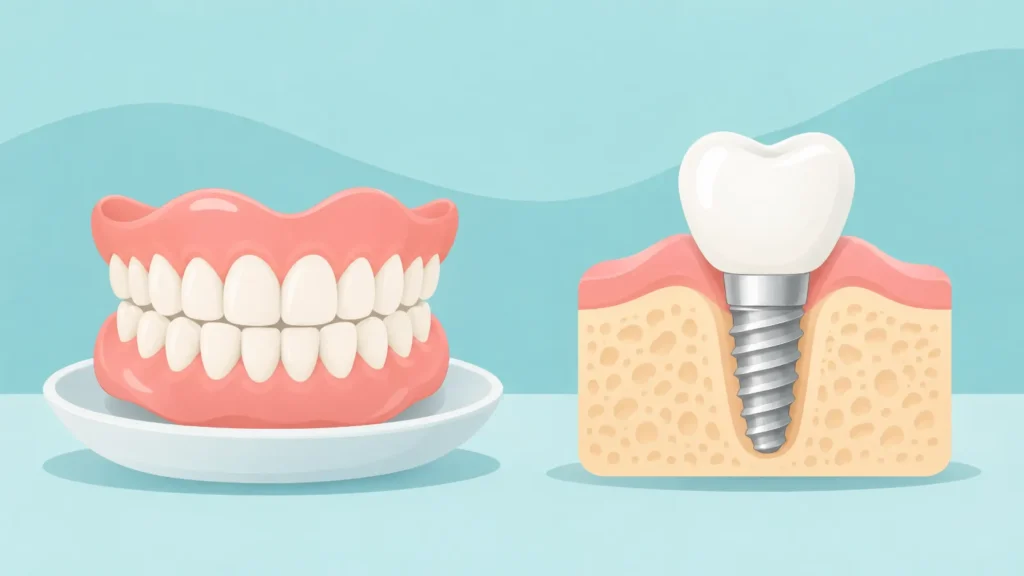
| Traditional dentures | May need replacing every 7 to 15 years (AAOMS) | No surgery; AAP says they are removed, cleaned after eating and soaked overnight |
AAOMS says implants likely will not affect neighboring healthy teeth or lead to bone loss in the jaw, compared with fixed bridges or removable dentures, and the FDA says implants help preserve jawbone and keep nearby teeth stable. The full comparison, including daily care and cost, is in our guide to implants compared with dentures.
Sometimes waiting is the better move. AAP describes ideal candidates as having healthy gums free of periodontal disease and enough jawbone, and ADA’s MouthHealthy says chronic illnesses such as diabetes may interfere with healing and that a physician may need to evaluate you first. If gum disease is active or diabetes is not under control, your dentist or oral surgeon may want those treated before surgery.
How is implant lifespan sold?
Having spent 18 years in finance and insurance performance marketing, I have seen lifetime claims run as headlines while the conditions behind them, proper care and good health, sit lower on the page. The other common gap is a quote that prices the post and treats the crown as a footnote, even though the crown is the part most likely to need replacing.
Ask whether a quote includes the abutment and crown, and what a replacement crown would cost later. The breakdown of implant costs covers what single-tooth and full-mouth quotes tend to include.
What helps an implant last as long as possible?
- Clean around the implant every day. AAP says to brush and floss as you would natural teeth.
- Keep regular dental visits. AAP says implants should be monitored as part of a full gum evaluation, and the FDA ties visits to long-term success.
- Stop smoking and vaping. The FDA links smoking to poorer healing and long-term success.
- Keep diabetes managed. NIDCR says poorly controlled blood sugar raises the risk of mouth problems.
- Report problems early. Tell your provider right away if an implant feels loose or painful (FDA), and mention red, tender or bleeding gums (AAP).
- Keep the brand and model on file. The FDA suggests it, and a future dentist may need it for repairs.
- Plan for the crown’s lifespan. Ask what a replacement would involve and cost.
Questions to ask your dentist or oral surgeon
- What crown material are you planning, and how long do you expect it to last in this spot? The MedlinePlus range covers crowns in general, so ask about yours.
- What would replacing the crown involve, and what would it cost? Ask whether the abutment would need replacing too.
- Do I have any of the risk factors the sources name? AAOMS and AAP list low bone density, past gum disease, poor plaque control, smoking and uncontrolled diabetes.
- How often should the implant be checked? AAP says implants should be monitored as part of a full gum evaluation.
- Which implant brand and model are you using? The FDA suggests keeping that record for future repairs.
Frequently asked questions
Can a failed dental implant be replaced?
Often, yes. AAOMS says treatment for an implant that did not heal can include removing it, placing a bone graft, waiting for healing and placing a new implant. Whether that fits your mouth is your dentist or oral surgeon’s call.
How long does the crown on an implant last?
None of the sources used here gives a lifespan for implant crowns specifically. MedlinePlus says most dental crowns last at least 5 years and some last 15 to 20 years.
Can a dental implant get a cavity?
The sources used here do not address decay in the implant or its crown. AAP says bacteria can build up around an implant below the gum line and cause peri-implant disease, so brushing and flossing still matter.
What is the success rate of dental implants?
AAOMS gives an overall success rate of up to 95 percent for implants placed by oral and maxillofacial surgeons (page updated 2026). It is a professional association figure and does not state a time period.
Will Medicare pay to replace an implant or crown?
In most cases, no. Medicare.gov says it does not cover items like dentures and implants, with narrow exceptions tied to hospital stays or certain covered medical treatments.
Am I too old for an implant to be worth it?
AAOMS says most patients are candidates regardless of age, and ADA’s MouthHealthy says general health matters more than age. Your dentist or oral surgeon weighs your health and bone.

Review status: Not yet reviewed by a dentist. This guide is general information, not medical advice.
Sources
- AAOMS (professional association): Dental Implant Surgery
- MedlinePlus: Dental crowns
- FDA: Dental Implants: What You Should Know
- AAOMS (professional association): Are Dental Implants Permanent?
- NIDCR: Oral Health in America, Executive Summary (2021)
- American Academy of Periodontology (professional association): Peri-Implant Diseases
- NIDCR: Diabetes and Oral Health
- NIDCR: Periodontal (Gum) Disease
- American Dental Association (professional association), MouthHealthy: Implants
- Medicare.gov: Dental services